
Labyrinthian Ways

In my last few posts I’ve mentioned how much I’ve been enjoying the Jesuit Media Lab’s “In Praise Of” Lenten series.1 My own entry was published this week; normally I just post a link to my stuff that gets published elsewhere,2 but these essays don’t seem to have digital home outside of email, so with the permission of the JML I’m reposting it below.
But first, a few outtakes! As any writer knows, part of the writing process involves removing elements that end up not fitting the final project.3 While I was writing this essay, way back in August and September (which, given the state of the world, feels like several eons ago), I made a lot of notes about the appearance of labyrinths in literature, because I was planning to work these allusions into the piece somewhere. Ultimately, this was a dead end of an idea, so here are a few literary labyrinths that didn’t make the cut:
My youngest loves Greek Mythology, so we’ve read and listened to many versions of the stories involving King Minos, the Minotaur, Daedalus, Theseus and Ariadne.4 I highly recommend the podcast Greeking Out if you have kids who love mythology.
It pained me deeply to not work in some connection to the Jim Henson movie Labyrinth, which we had recently shown to our (then) 8 year old. It really holds up!
Graham Greene’s The Power and the Glory, which is on the very short list for ‘greatest Catholic novel written in English,’ was initially published in the United States as The Labyrinthian Ways.
This was an allusion to Francis Thompson’s classic poem “The Hound Of Heaven” (1890), about the unrelenting ways in which God pursues us, which begins:
I fled Him, down the nights and down the days;
I fled Him, down the arches of the years;
I fled Him, down the labyrinthine ways
Of my own mind; and in the mist of tears
I hid from Him, and under running laughter.
You’d be hard pressed to find a novel more invested in the idea/ metaphor of the labyrinth than John Green’s Looking for Alaska. I think John Green is the best, and I might someday write a real essay on this book, but in the meantime here’s one (of many) excellent labyrinth-related quotes from the book:
“You spend your whole life stuck in the labyrinth, thinking about how you’ll escape one day, and how awesome it will be, and imagining that future keeps you going, but you never do it. You just use the future to escape the present.”
Green also spends some time on whether or not Simon Bolivar’s last words were really: “Damn it, how will I ever get out of this labyrinth!” (which comes from Gabriel Garcia Marquez’s The General in His Labyrinth). (They probably weren’t — but it’s still a (damn) good question.)
Ursula K. Le Guin’s The Tombs of Atuan also needs to be on any list of novels including labyrinths. So creepy and strange — all the Earthsea books are amazing.
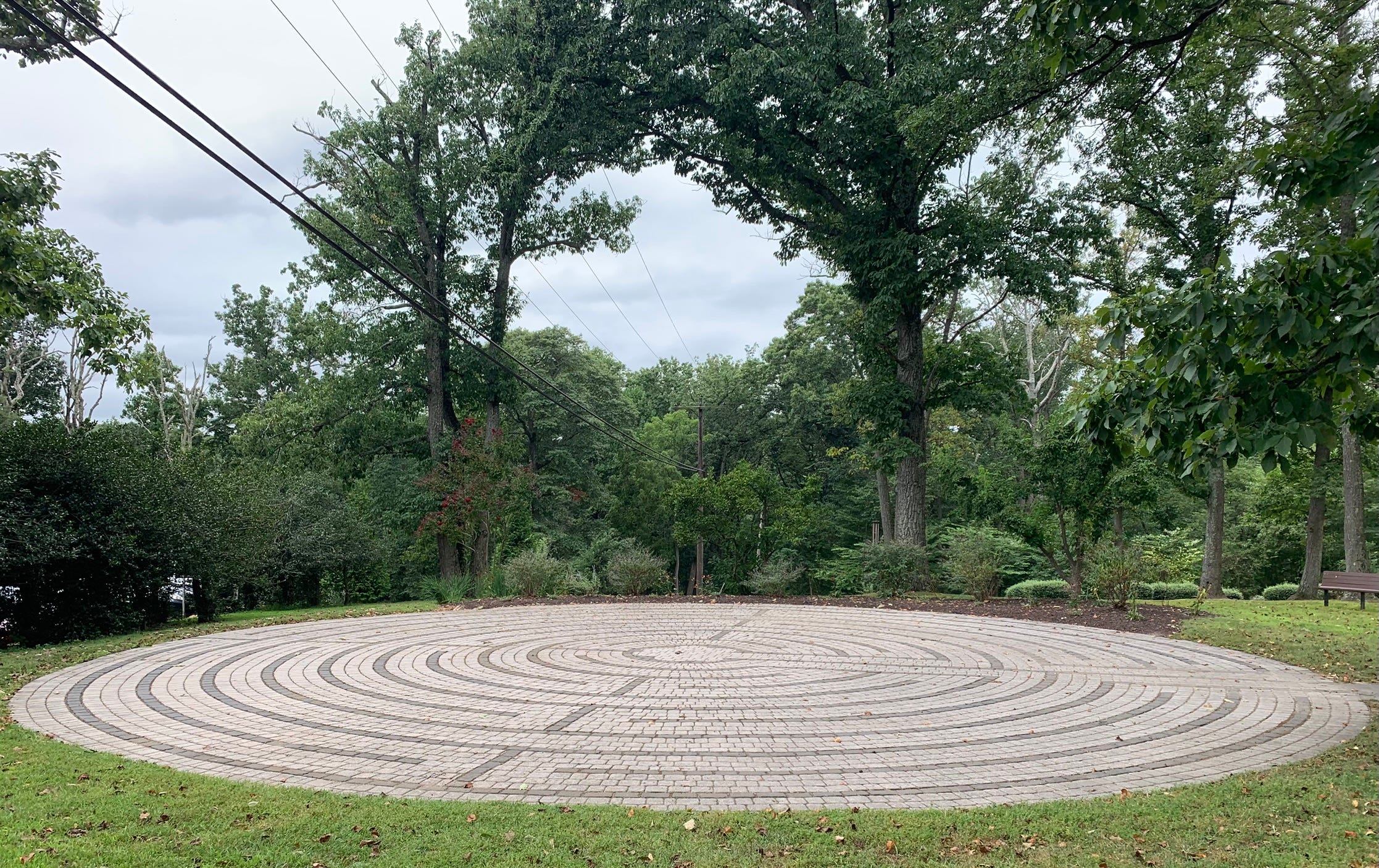
Okay, without further ado, here is my “In Praise of Labyrinths”:
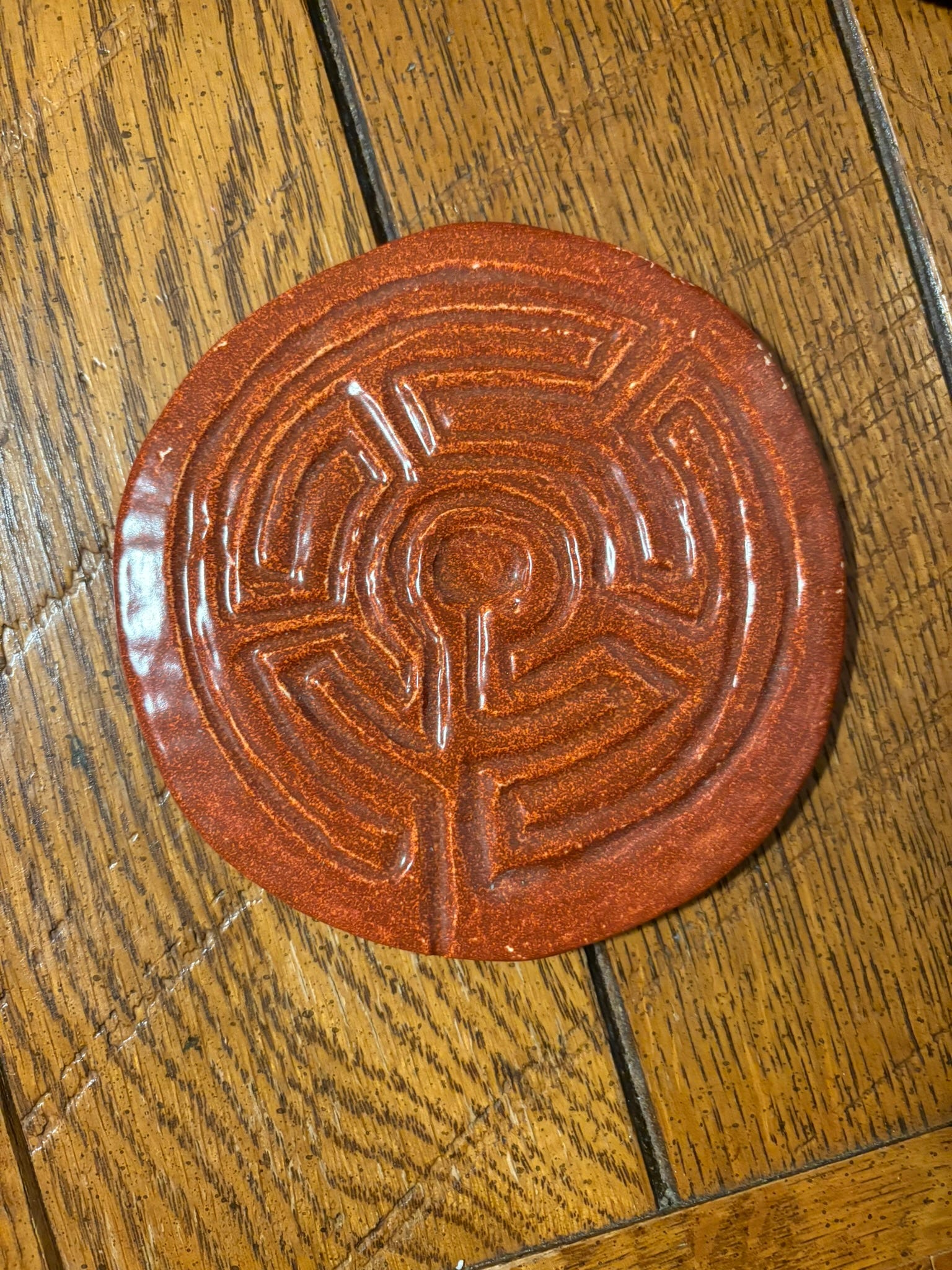
For the past year or so, there have been labyrinths all over my house. My wife got into making finger labyrinths in a pottery class, so we’ve been inundated with printouts of labyrinth templates along with actual ceramic labyrinths, circle and square, ranging in size from coasters to trivets. The swirling and winding designs of the paths are very beautiful. At first glance, they look like mazes, but any labyrinth has only one pathway to follow. It loops and curls, but there’s no way to get lost or take a wrong turn; the path always leads inexorably from the entrance to the center. One doesn’t have to find one’s way through the labyrinth, one just has to persevere.
I can’t claim to have given labyrinths much thought before this recent inundation, but (as is so often the case) once they came into my consciousness I began to notice them all over the place. A remarkable number of hotels and hospitals and church grounds have them. There is one on the grounds of the retreat center that hosts the annual Ignatian Creators Summit. (I wrote a bit about it here.) There’s one in my hometown in the park where we used to have cross-country meets. There’s a good chance you’re only a few miles from one right now. (This website can help you find one.)
Whether I’m walking one, or just tracing my finger along a labyrinthian path, I have found it to be a very useful experience in terms of grounding myself during prayer. I find it difficult to sit and meditate, or to immerse myself in silent prayer. I walk to think, and I pray best when moving. If I need to be still, running rosary beads through my fingers helps. The finger labyrinth does something similar — it provides a tactile, embodied element that helps keep my mind from wandering too much.
But I’ve found walking a physical labyrinth does something more profound. Some of my most powerful prayer experiences of the past few years have come while walking a labyrinth. There is something about crossing into that enclosed area, with its clearly marked outer boundary and the winding path within it, that signifies to my psyche that I’m entering a sacred space. It is very clear, when taking that first step on the labyrinth’s path, that I have moved into a place set apart for doing something outside of my normal routine, and this seems to open me up for a deeper encounter with the movement of the Spirit.
The symbolism of the labyrinth is obvious, but no less true for being so apparent: the winding path, with its clearly marked beginning and ending, and the meandering but continual steps between the two, is clearly a life in miniature. We know how it starts, and how it will one day end, but we don’t know how we will get to that endpoint without actually taking the steps. And as we move through it, although the way might be laid out before us, we can only see — and take — the next step in the path. While we’re in the midst of it, we cannot see the whole picture.
But the labyrinth isn’t just a metaphor for our life’s journey; it also serves as a model for the spiritual (and/or creative) life. When we’re walking the labyrinth, we don’t really know where we are on the overall journey; the path might lead us very close to the center — we can see our end goal is just one step over — but as it turns out, we’re not going to actually get there for quite a while. The path is going to lead us out and away and around, and we’ll go through a period where we know we are far away from where we want to be, but as long as we don’t give up, we’re still going to get there.
So we need to commit to the process. While we’re walking, we can glance around and take in our surroundings, but in order to not wander off the path we need to keep our heads down and focus on where our feet are going. If we look too far ahead, or anticipate what we think is coming, we’re going to take a wrong step. This careful attention helps ground us, and, at least in my experience, it occupies just enough of my physical and mental energy to keep me alert while also freeing my mind up for true prayer.
The final reality of walking the labyrinth is that we will take a lot of steps and not actually go anywhere. We’ll eventually reach the center and then have to just casually step out, across the beautiful, intricate path, and go back to the normal world. But this, too, is a helpful reminder: We can make the effort, put in the work and achieve something internally, but to others it might not look like we’ve been productive at all. And this is fine! Not all meaningful and transformative experiences are immediately apparent to others; we need to commit to the journey regardless.
Inside of the labyrinth or outside of it, we can have moments when we feel overwhelmed as we contemplate the biggest picture: our final destination and the long meandering path it’ll take us to get there. But the path is still laid out in front of us, and we are going to follow it regardless. We don’t really need to worry. We just need to be present and trust the next step.
Postscript:
In addition to cutting the literary allusions from the published version, I also took out a more personal digression that felt like an unnecessary loop in the narrative. But as a special bonus for you subscribers (and because I liked it), I am gonna include it here:
There’s actually a labyrinth next to the parking lot of the hospital where I used to work, 20-some years ago. I never walked it while I worked there — in those days I wasn’t the type to walk a labyrinth, even though I was devastatingly bored at that job, and would quickly volunteer for any and all offices errands so that I could kill time walking the hospital corridors in long recursive paths. It was a time in my life when I was simply marking time: earning money while my wife was in med school, waiting to get back to grad school myself, when real life would begin again.
It’s easy to say this, too, was “real life” — that those minutes and hours and weeks and years were no less significant than the ones that had come before, or would come later, but in reality those years take up almost none of my memory. It was a period I endured, before moving on to other, better, times. We all move through periods in our life where we’re more awake, more vibrant, and periods where we simply hunker down and endure.
Either way, they’re all just steps in the labyrinth. At times we’re close to the center and times when we’re on the edge. But there are also times when we’re trudging through a little recursive loop, filling in the space but not really getting anywhere. And this is not necessarily bad; the steps are still necessary. We’re always, on some level, moving forward. But it’s okay to acknowledge that some passages are more interesting, more dynamic, more scenic, than others.
I hope wherever you are on your own journey through the labyrinth, whether you are experiencing one of the easier sections or in the midst of a dark part of the path, you know you are not journeying alone.
You can still sign up for it here — Lent is not over! — and you’ll get a pdf of all of the entries, including the delightful artwork, around Easter.
For instance, here’s a link to an essay I wrote for Busted Halo about a pair of married martyrs from the 3rd century, and my general dislike/ distrust of hagiographies.
Kill your darlings!
Just yesterday I read this absolutely fascinating (and relevant!) paragraph in Martha Barnette’s book Friends with Words: Adventures in Languageland: “One year, the hero Theseus joined the other Athenian youths who were sent as tribute and paraded in front of the royal family. When the king’s daughter saw Theseus, she fell in love with him and somehow managed to get him aside from the rest. Then she secretly gave him a ball of thread and told him to tie one end of the thread at the entrance and unravel it as he ventured deeper into the maze. That way, he could kill the Minotaur, then follow the thread to find his way back out. He did just that. Which brings us to the Old English word cliewen. In Old English, cliewen could mean “a globular mass” or “a round bunch” or cluster of things. But it could also mean “a ball of yarn” — and over time, clew came to specify the ball of yarn used by Theseus and other mythological characters to find their way out of mazes. This word later came to indicate anything that points the way or provides guidance in solving a puzzle or mystery. And today we spell it not as clew, but as clue.”