
On Epiphany/ Epiphanies
Some thoughts on the most literary of Feasts

Yesterday was Epiphany, and for whatever reason, the particular uniqueness of this feast/ celebration really resonated with me this year.1 At Mass on Sunday, as the priest was giving his homily on the arrival of the Magi, it occurred to me that Epiphany is perhaps the most literary of Church feasts. In terms of the actual historical things that (supposedly) happened and that we are commemorating, we are presented with a truly incredible cast of characters and fascinating narrative beats.
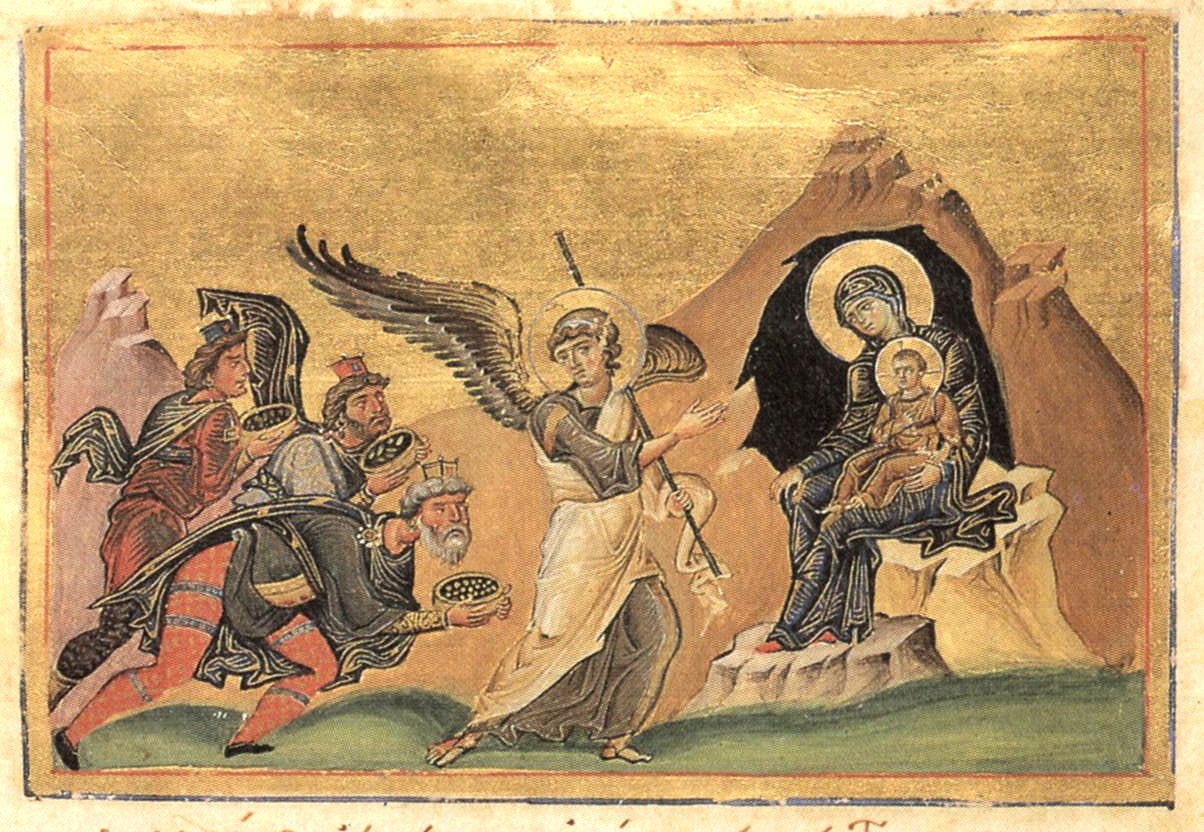
We have the three Magi (wise men? astronomers? kings? magicians??) coming from Persia; whole books can be (have been) written on their backstories, and the things they represent theologically and historically. We have King Herod, the person in power who feels threatened and resorts to subterfuge to try to identify his enemy. We have the baby Jesus, the Christ child, God as helpless infant.2 We have his parents, who must have been surprised to find these rich, exotic travelers arriving at their door, presenting them with extravagant (and impractical) gifts. And we have the gifts themselves — gold, frankincense, myrrh (traditionally representing kingship, divinity, and death) — being given to a relatively poor couple. And over it all we also have the star — the light shining in the darkness, marking the arrival of God on earth, leading those who have the desire and the ability to see and follow it — which is, to me, the most beautiful symbol in all of the gospels.
And we also have all that the journey of the Magi sets in motion — the massacre of the innocents and the flight into Egypt. None of this might be historically accurate, but it all makes for an extremely compelling, and symbolically rich, narrative. From the very first moments of Christ’s story, we see the extremes the powerful will take to eliminate threats to their control, and we see how God’s plan defies human expectations, and we see that Christ has come for all people, and that study/ learning helps us to come to know Him, and we find God aligning, once again, with the refugee and the vulnerable.
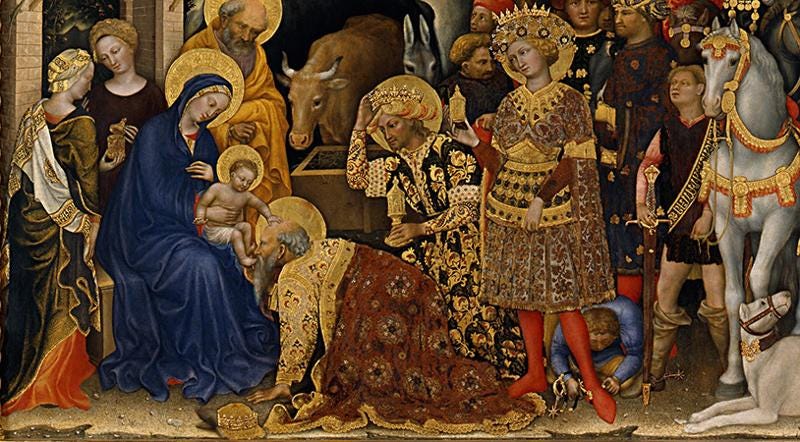
Given the rich source material, it’s not surprising that the feast of the Epiphany has been an inspiration for so many writers and artists over the years. There is of course “The Gift of the Magi” by O Henry (which is actually quite a lovely story, even if at this point it comes across to us as a bit trite and overly familiar), which includes this memorable coda:
The magi, as you know, were wise men—wonderfully wise men—who brought gifts to the newborn Christ-child. They were the first to give Christmas gifts. Being wise, their gifts were doubtless wise ones. And here I have told you the story of two children who were not wise. Each sold the most valuable thing he owned in order to buy a gift for the other. But let me speak a last word to the wise of these days: Of all who give gifts, these two were the most wise. Of all who give and receive gifts, such as they are the most wise. Everywhere they are the wise ones. They are the magi.
We also have TS Eliot’s Epiphany poem “Journey of the Magi,” (you should definitely click the link and listen to him read it!), which isn’t one of my favorite Eliot poems (there’s a bit too much grumbling over the logistics of travel), and it’s a downer, but the ending is certainly memorable:
We returned to our places, these Kingdoms,
But no longer at ease here, in the old dispensation,
With an alien people clutching their gods.
I should be glad of another death.
(Christmas is here!!)
And there are Joseph Brodsky’s Christmas poems, which Cameron Bellm introduced me to (and reflected on beautifully in her own Epiphany essay in America) — “Star of the Nativity” is particularly fitting for the feast of Epiphany. And there’s Louise Gluck’s odd “The Magi,” and WS Merwin’s beautiful “Carol of the Three Kings.” And I have no doubt there are countless other poems about the Epiphany — as I say, it is an incredibly rich subject for imaginative exploration.
Epiphany also always makes me think of Arthur C Clark’s “The Star,” a science-fiction story about a Jesuit astrophysicist discovering the remains of an alien civilization that has been wiped out when their star goes supernova; in the last lines of the story we learn the truth that has shaken our narrator’s faith — that their exploding star is the same star that once lit the Magi’s way:
“There can be no reasonable doubt: the ancient mystery is solved at last. Yet, oh
God, there were so many stars you could have used. What was the need to give these
people to the fire, that the symbol of their passing might shine above Bethlehem?”
(Again, Merry Christmas!!)
But really, after years in grad school, what I always think of when I hear the word epiphany is James Joyce’s thoughts on literary epiphanies — that stories should build to a shock of revelation, sudden insight, the light coming on in the darkness. Moments when the ordinary is transformed and reveals its true essence. In Joyce’s fiction, this is not always a happy occurrence — often the epiphanic insight that he arrives at is sort of crushing — but it is still beautiful.3


So where does this leave us all? I honestly don’t know. We might think of the moment of epiphany as the time when all the pieces finally fall into place and we can see the bigger picture at last; where the disparate and disorded finally take clear shape. But at this moment I don’t feel like the pieces align; they are on the table but I don’t see how they fit. Yesterday was January 6th, the fifth anniversary of a mob storming the capitol, for which no one was ever fully held accountable, and we are now living in the world shaped by that catastrophe and that failure, where the powerful are only further emboldened to wield their might without care for consequence or repercussions. There seems to be only power and the desire to impose it.
So right now feels more rough beast crouching towards Bethlehem, more alien people clutching strange gods, more un-illuminated darkness, than it does new birth and wondrous revelations. And yet I do still feel the hope for, and belief in, the flash of insight and moment of illumination that will come. The light is still shining in the darkness, even if we do not yet see it. May we still feel its warmth.
And may we be alert to signs that might point the way. May we take the time to study, to prepare ourselves, to learn what we need to know in order to track its light, and follow its path, and ultimately encounter the revelation that will sustain us in the work we need to do to resist the darkness.
I know that in certain parts of the world Epiphany, or Three Kings Day, is celebrated as a gift giving holiday, which to be honest makes a lot of sense and seems pretty fun! It wouldn’t be bad to space out the theological and commercial aspects of Christmas a bit — it’d give us all a little more time to ponder the wonder / mystery / awe of God becoming a human baby, before we go all in on the Lego sets and video games.
Who is often depicted still in the manger, or hanging out in the stable with Mary and the cows, when they arrive, but I don’t think this is right? Matthew says “Now after Jesus was born in Bethlehem of Judea in the days of Herod the king, behold, wise men from the East came to Jerusalem.” So if the wise men came to Jerusalem after Jesus was born, by the time they actually find him, Mary and Joseph are presumably back to their home, or at least settled somewhere more permanent in Bethlehem, right? It’s not entirely clear to me how much time was supposed to have elapsed between Christmas and the arrival of the three kings — though since Herod ends up ordering the killing of all boys under 2, it seems like kind of a lot.
Read more of my thoughts on literary epiphanies in my book Startling Figures! :)
Loved this literary (and artistic!) roundup! This is definitely my favorite feast, and this year I've been so moved by the dream of the magi, and by the instruction to go home by another way.